
A different way to gain access to the corporate debt risk premium.
Over the past three decades, regulatory reform and industry consolidation have driven banks away from corporate lending activity. To fill the gap, private direct lending emerged with independent asset managers funded by capital from institutional investors, replacing banks as providers of secured first-lien commercial loans. By 2024, according to the International Monetary Fund, the private credit market has grown to more than $2 trillion globally, about three-fourths of which is in the United States, where its market share is nearing that of syndicated loans and high-yield bonds.
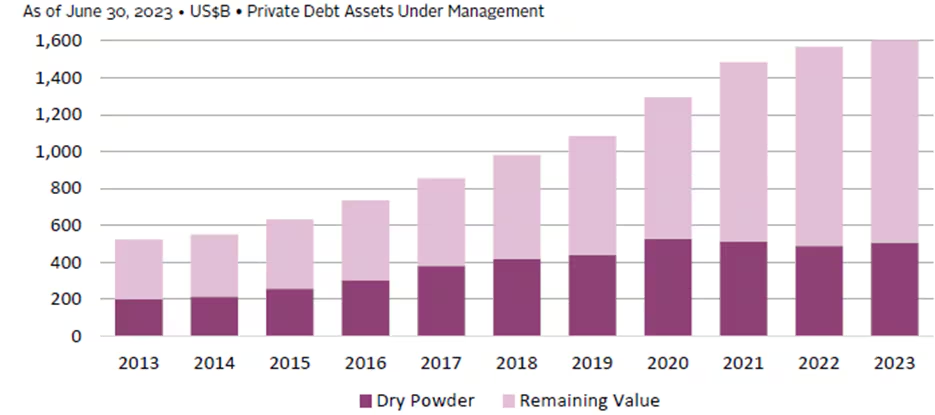
The market has grown rapidly, and the speed, flexibility, and certainty of execution that direct lenders provide have proved valuable to borrowers and their private equity sponsors. Although private credit is illiquid, institutional investors such as pension funds and insurance companies are attracted by the higher returns and reduced volatility.
Characteristics of Middle Market Loans
Commercial loans made by asset managers or other nonbank lenders typically have a five- to seven-year maturity (though effective maturities have been roughly three years because of early repayments) and charge floating interest rates based on a reference rate, such as the one- or three-month secured overnight financing rate, plus an interest-rate spread to compensate for the risk of loss from borrower default. The interest spread varies depending on many factors, including the perceived riskiness of the borrower, industry, loan/value ratio, seniority, covenants, and other factors. In addition to interest income, lenders receive an “original issue discount” for originating and underwriting the loan. Original issue discount is received when the loan is issued in the form of lender proceeds that are 1% to 3% less than the final principal. This upfront price discount is generally considered additional interest income and is amortized over the life of the loan. In addition, middle-market loans receive fees for loan prepayments, which can total a one-time 1% to 2%.
Middle-market loans are generally not rated, are considered non-investment-grade, and are not traded in the secondary market. As a result, yields are generally greater than traditional broadly syndicated bank loans and publicly traded high-yield bonds.
The growth in direct middle-market loans originated by asset managers is partly explained by the growth in middle-market private equity. These loans are referred to as “sponsor-backed.” Private equity sponsors often prefer to borrow from asset managers rather than traditional banks because asset managers offer speed, certainty of execution, and greater financing flexibility.
Investors in middle-market loans can preselect the types of risks they want to take. For example, many investors, particularly first-time investors, choose the least risky senior secured loans, with yields currently averaging about 11%. More-experienced investors, or those seeking further diversification, may be comfortable investing in second-lien or mezzanine loans, with yields currently in the 13% to 15% range. Investors may also choose middle-market loan funds that use some leverage. Portfolio financing is readily available to managers with strong track records and performing loan collateral, and private funds focused on senior secured loans often use one to two turns of leverage to enhance returns.
Middle-market loan performance is the combined outcome of (1) interest income, (2) realized losses through impairments, (3) unrealized net gains or losses from periodic valuations, and (4) fees and expenses.
Larry Swedroe is the author or co-author of 18 books on investing, including his latest, Enrich Your Future: The Keys to Successful Investing.